 |
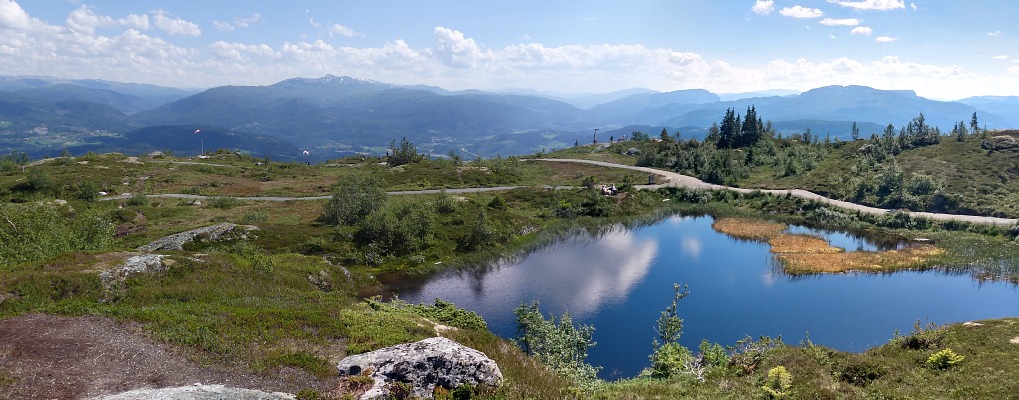
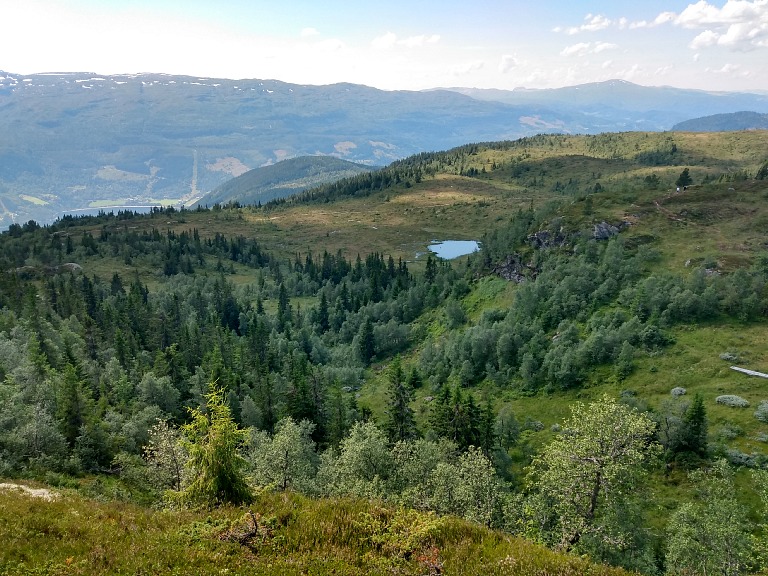
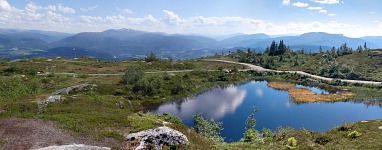
| Even on the very top of Hanguren mountain in the Voss ski resort, an obligatory pond awaited us. |
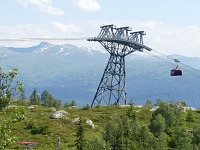 |
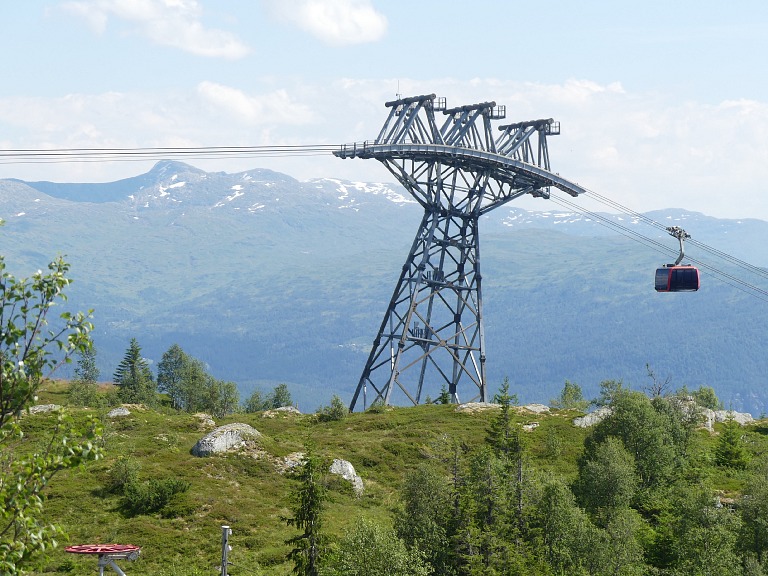
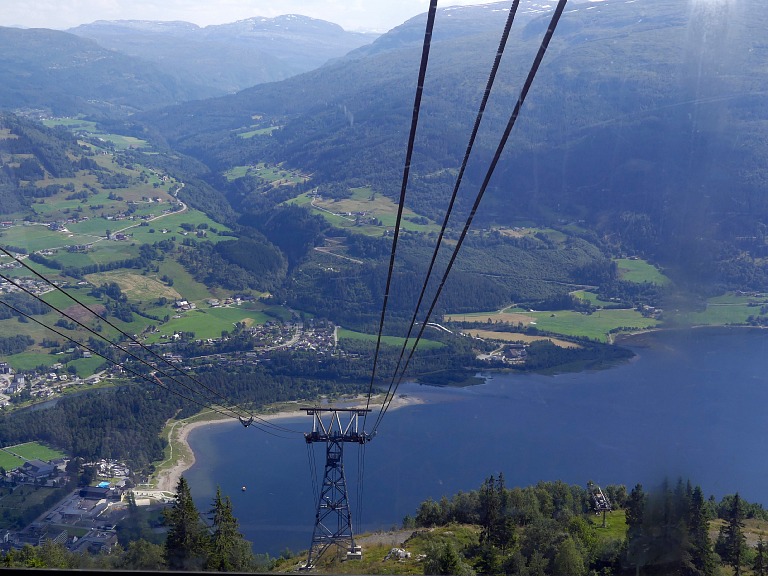
| One can ride a gondola with an awesome view up to Hanguren. |
On Friday morning we said good-bye to Vanessa and the Little Palace, and set out
to the mountainous section of our trip. That is, we had been through some hills
before, but now we were entering the area between Folgefonna and Hardangervidda
— and the Voss ski resort became our intermediate destination. It does
mercifully feature a gondola that would take you from about six hundred feet to
above twenty five hundred. We hoped that weather on top of the Hangur mountain
may not be as hot, and there should be places to go for a hike, just a
"level path around a pond" or something like that. Veteran readers of
these journals surely suspect, where I'm headed with that expression.
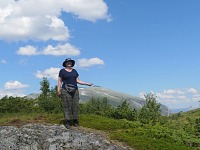 |
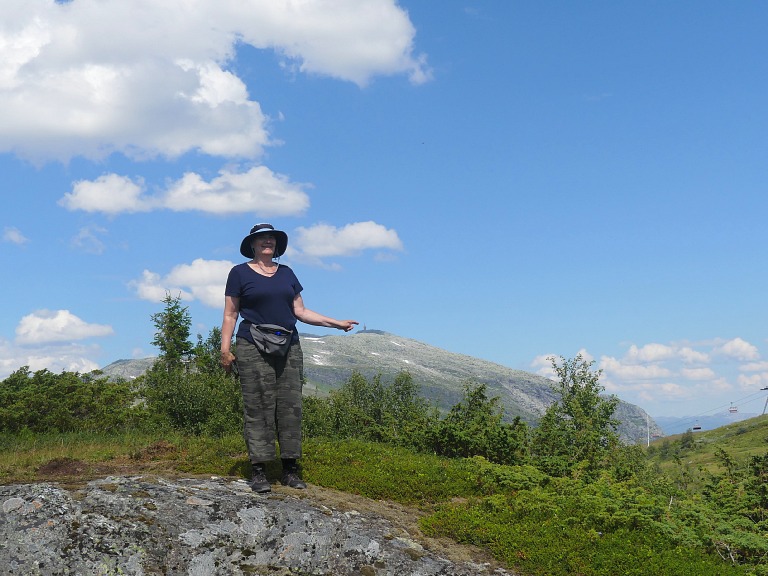
| Carol points to Lønahorgi Mountain (1415 m), to where we of course did not hike. |
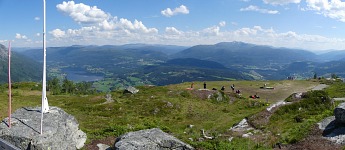 |
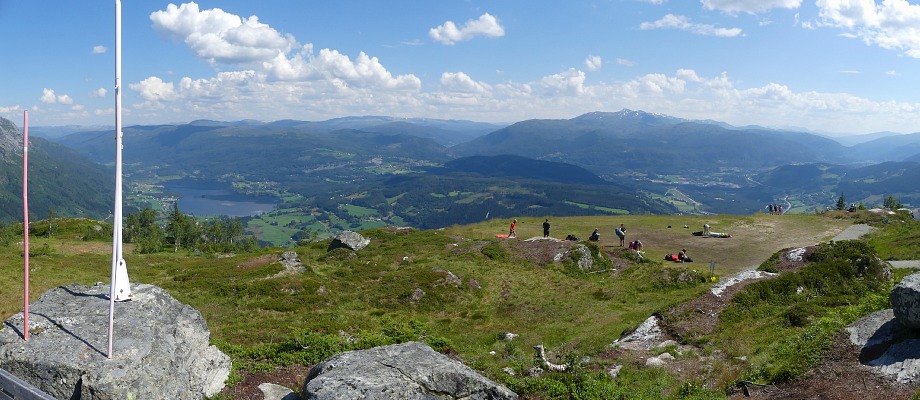
| Paraglider pilots for some reason suddenly quickly pack their gear. |
Voss town surprised us by how big it was, but even there we eventually found
a parking spot (naturally, paid), and obtained tickets for the gondola. Views
from the lift are awesome, and so are those from the top of the mountain.
Hangur is apparently popular with paraglider pilots, and we were able to admire
courageous aeronauts in action. It's funny how this spot blurs in my mind with
my trip to Bavarian Brauneck of previous year. Sid did not share this (for not
having been there), but the trip in a gondola to a hilltop with paragliders,
a view and a hiking round was very similar — it only differed in that on
Brauneck we had been wrapped in windbreakers.
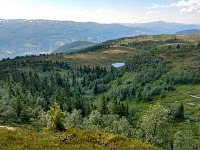 |
| Our trail named Grebbeløypa offered beautiful views, like this one to the west. |
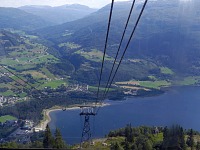 |
| Lake below is called Vangsvatnet, and the valley running south is Bordalen. |
Here, except for a twitch of a draft in the gondola terminal, we remained in
hot air. Still we enjoyed the fact that tourists at the top tended to disperse
in all possible directions, and soon we were left on our own with the nature.
Gazing into a handy map, we picked a loop trail that seemed appropriate to our
capabilities with its 2½ miles, and the fact that it was already
afternoon and we still needed to drive the rest of our distance to Fossli hotel.
What we should have considered were weather conditions — horrible
afternoon heat — and the absence of trees and shade. The landscape is
nevertheless awesome, and thus we did not regret our dragging on — except
perhaps the last two hundred yards uphill to the lift terminal along a dusty
gravel road. The terminal, fortunately, sports an (overpriced) restaurant, where
we were able to re-hydrate with electrolytes in a vitamin-infused drink (beer).
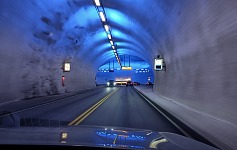 |
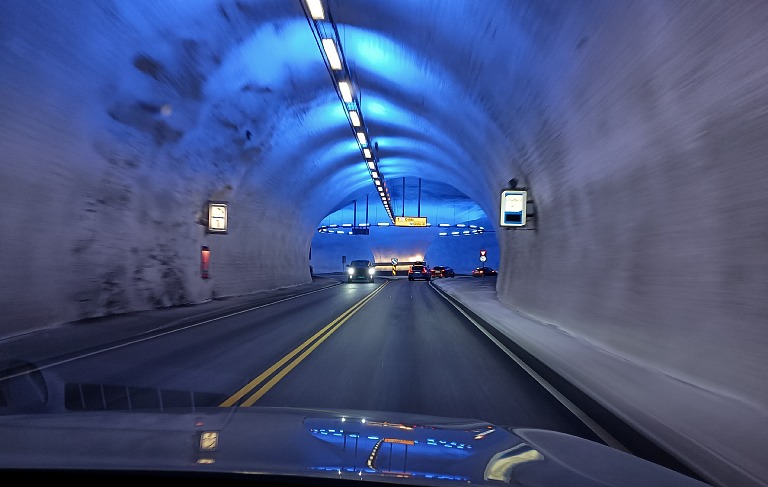
| A UFO-like roundabout popped up on us in Butunnelen. |
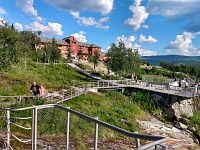 |
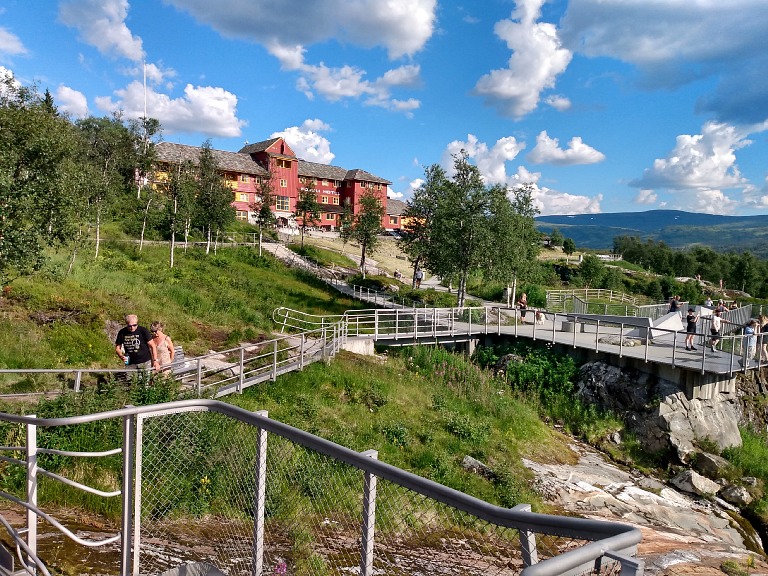
| Hotel Fossli and adjacent viewing platforms. |
Our final hope was to somehow reach our hotel and I must admit that at this
phase of Norwegian trip we were seriously tired. Soon, though, something new
shook us out of our tourist lethargy — by then we got used to road tunnels
in Norway (it was an effort with my claustrophobia) — but when the tunnel
ahead of us revealed something that looked like an alien mothership, and
subsequently turned out to be an underground roundabout, we were, admittedly,
unprepared. By next such roundabout in the next tunnel, we were even ready to
take pictures, but that was not the end of the surprises. One drives on a new
road up to Vøringsfossen, which — for a change — wraps around and
above itself, all inside the tunnels, so that the car's navigation screen looks
like a confused toddler's sketch.
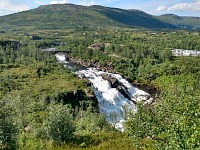 |
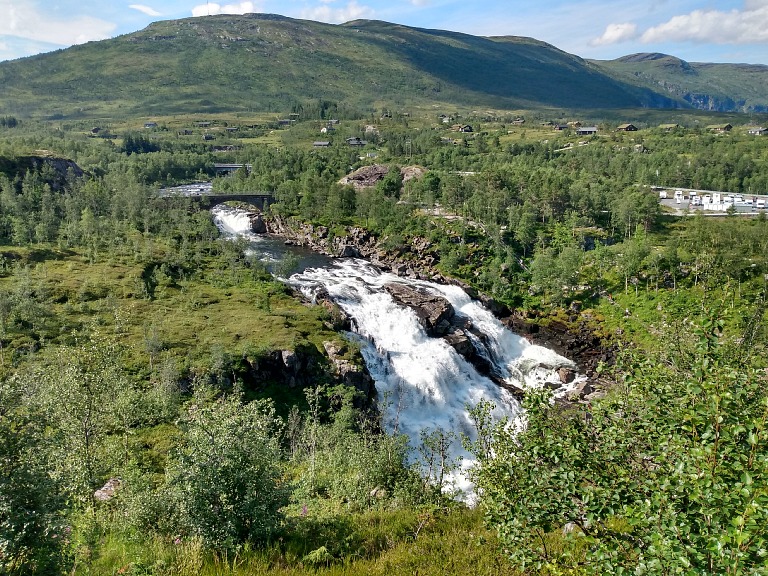
| A cascade of "mere rapids" above the large Vøringsfossen. |
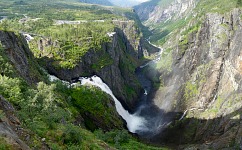 |
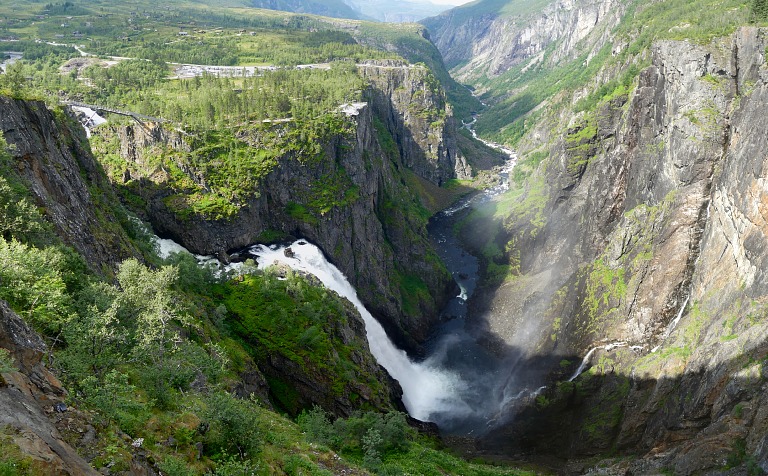
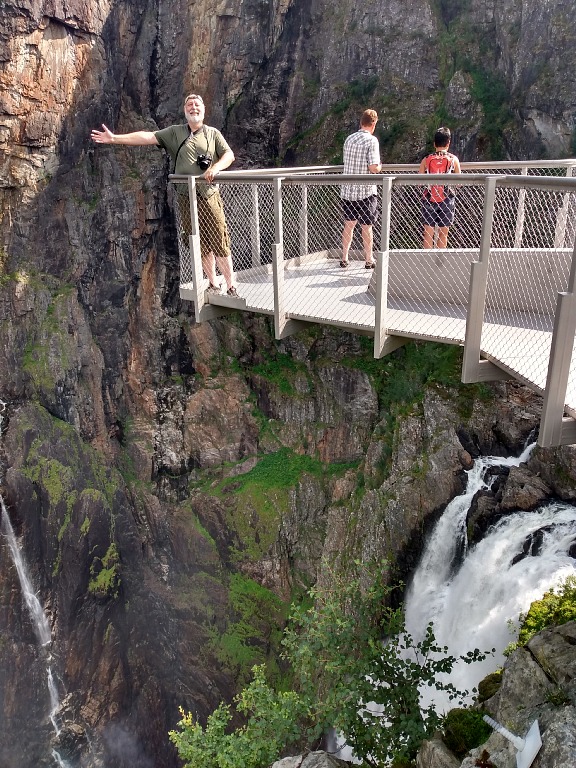
| Waterfalls Vøringsfossen (large, left) and Tysvikjofossen (small, right). |
We did not let it fool us and happily arrived to the historic Fossli hotel,
majestically overlooking Vøringsfossen waterfalls. Fossli used to be a pasture
utilized by Måbødalen farm, which in the year 1879 got purchased by a tourist
enthusiast Ola Garen, with the intent to build a hotel on a viewpoint above the
waterfalls. He had to be truly enthused, for first he had to build a road
— and even with it, all had to be carried on foot — shorter beams
and planks on pack animals, long ones had to be carried by people. Add short
Norwegian summers and you won't be surprised that the hotel got finished only
in 1891. Ola died at age fifty eight in 1915 and his son carried on the
ownership. Garens still own it today, and the building went through
reconstructions and extensions. It still keeps the air that I associate with
the charm of the era between the world wars. This fortunately does not include
bathrooms that are quite modern and functional instead.
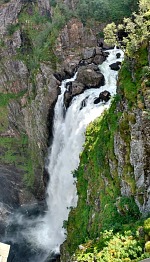 |
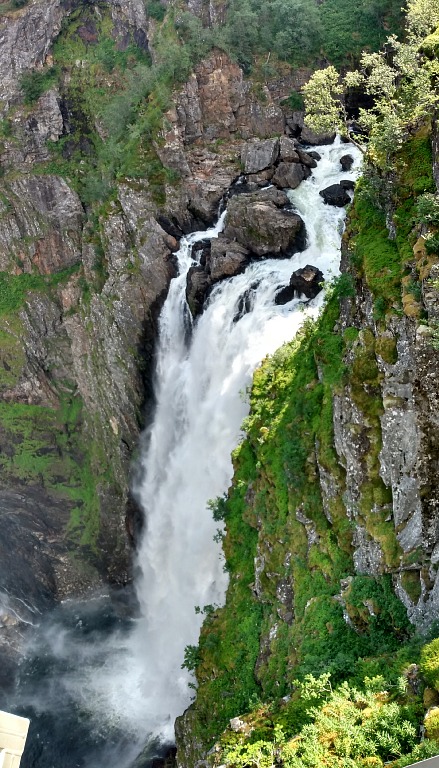
| Main drop of Vøringsfossen is supposed to measure 600 ft. |
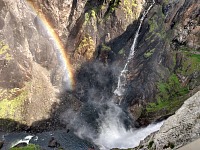 |
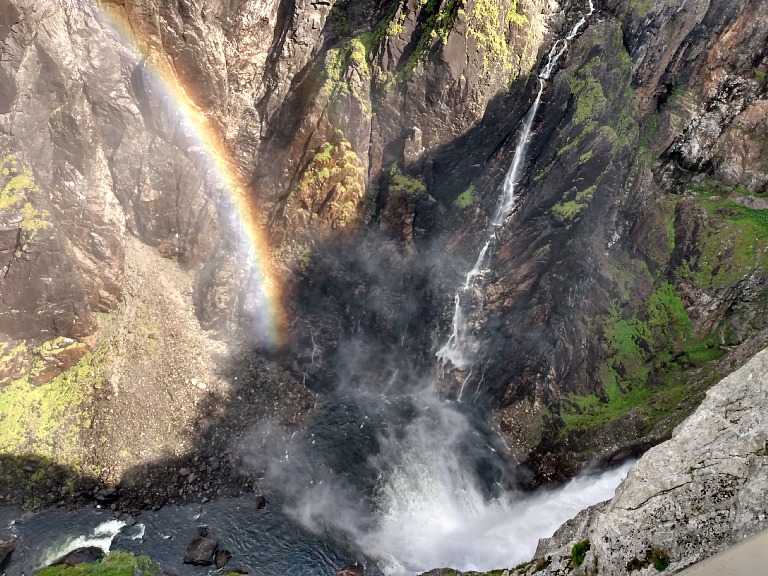
| Big Vøringsfossen pushes Tysvikjofossen with an air flow making a rainbow of it. |
We talked with the receptionist about where to go sightseeing on the next day,
and whether a glacier is visible from somewhere near — he recommended
taking a dirt road starting behind the hotel up to a lake, where one can bathe
(I really did not expect from Norway that my greatest worry would be where to
find a place to swim) — from where the glacier can be seen. We reckoned
that we still had time to view the Worthy Waterfalls (that's the name), now
that it roared right outside our window. In 1821, professor Christopher Hansteen
journeyed to Hardangervidda to perform astronomical observations, and local
guides took him to a waterfall that measured, according to them, at least half
a fjerding (1000 ft;). The professor did not wait and measured the falls
scientifically with a watch and falling rocks, estimating it to be 920 ft.
Today's official height is "mere" 600 feet, but it does not
diminish the majestic dignity of the waterfall — not even in the middle
of the summer and a low water level (whose minimum of 388 cuft/a is
maintained by a hydro power reservoir upstream). Much has changed since the
times of professor Hansteen. A bridge and an access road had been built by
a tourist club in 1872, at the occasion of visit by Price Oscar. Stone bridge
above the waterfalls got added in 1915, joined by parking lots and viewing areas
over time — from the Fossli hotel as well as from the road.
During Sid's trip to Norway in 1991, the expedition thus could view the falls
from those spots — I think that only a fraction of the participants, after
two months' worth of adventure, bothered to get out of the bus to see and take
pictures — "geez, another waterfall". Wanting to know how tall
the waterfall was, Sid, unaware of professor Hansteen, performed then the same
rock and watch experiment, obtaining a similar result.
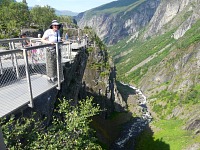 |
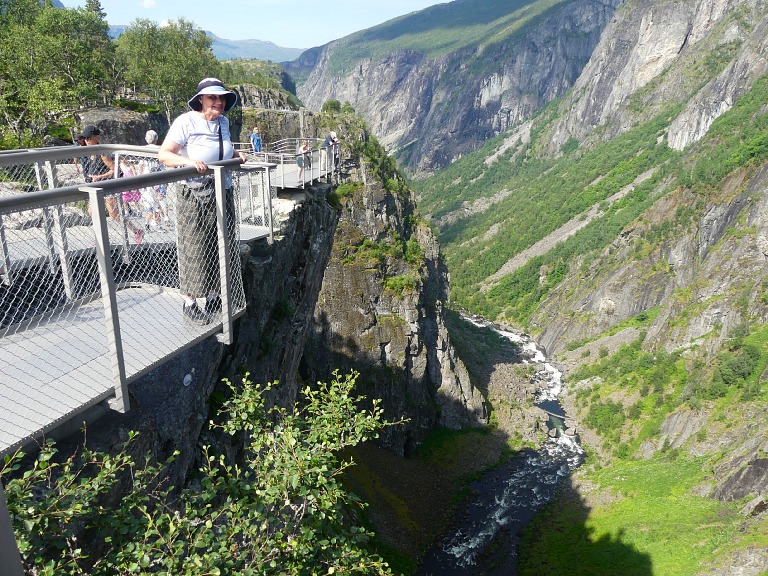
| Carol over a horrid drop-off. |
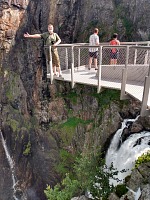 |
| Metal platforms strangely don's vibrate or sway. |
Controversial construction of a stair bridge over the spot where the fall
plunges into the abbys, was finished in 2020, along with securing trails and
viewing areas along the gorge. I haven't mentioned yet that the old Worthy
is not lonely — two more creeks fall of the edge of the same abyss, and
there's something to see from all angles. We still needed to eat dinner, so
we viewed only what could be seen from platforms right in front of the hotel,
and then arrived at the hotel dining hall (the only place with hot food far and
wide, not counting tourist café in the hotel's basement, which only offers baked
goods). The food was expensive, but in quality matching the price, and we
enjoyed ourselves. The server was grumpy, which we attributed to her youth.
Unfortunately, at breakfast on the following day it became apparent that the
whole staff spoke Russian.
Forget between-the-wars charm — we were suddenly
thrown into the era of socialist totalitarian years, with its ubiquitous
"we don't have it" as a standard reply; waiters not hesitating to
berate guests for using the wrong cheese knife (in all other hotels, cheeses
were presented cut already and guests did not have to wrestle them — and
manhandle the rest). For me, with my gluten free diet, selection was very narrow
— in the end, I found a little bowl of yogurt, but there was more or less
nothing available to add to it. The buffet was half eaten all the time, and our
requests for replenishment were met with a sneer and a brutal "we don't
have more".
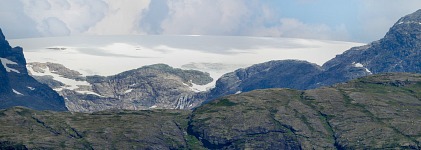 |
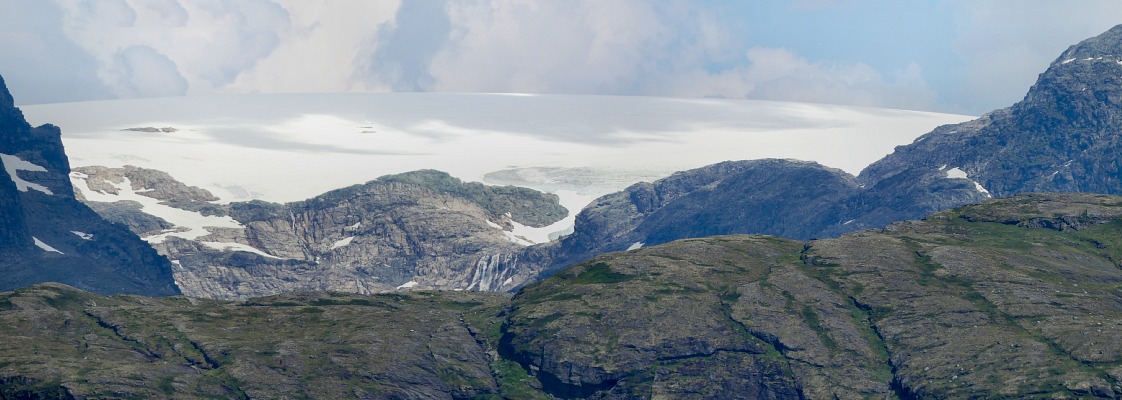
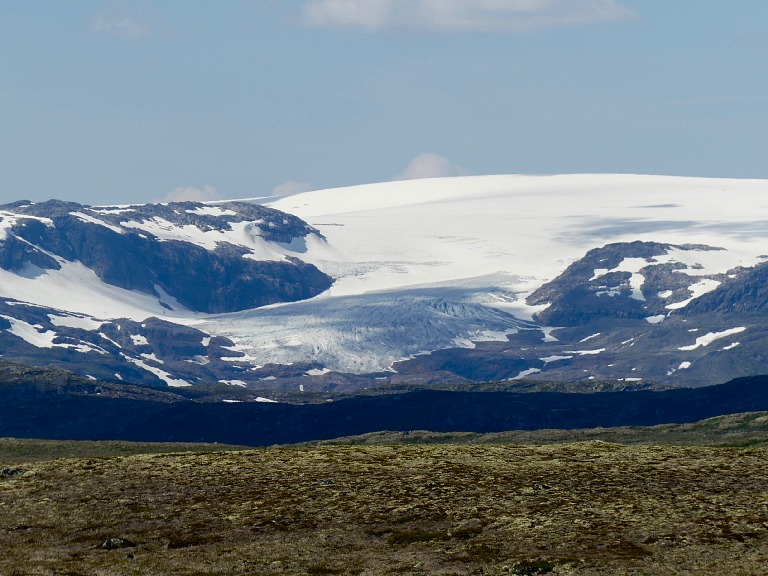
| It's always far to a glacier, even from Isdalen Valley. Zoom lens helps. |
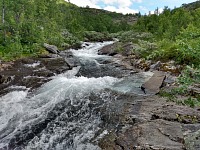 |
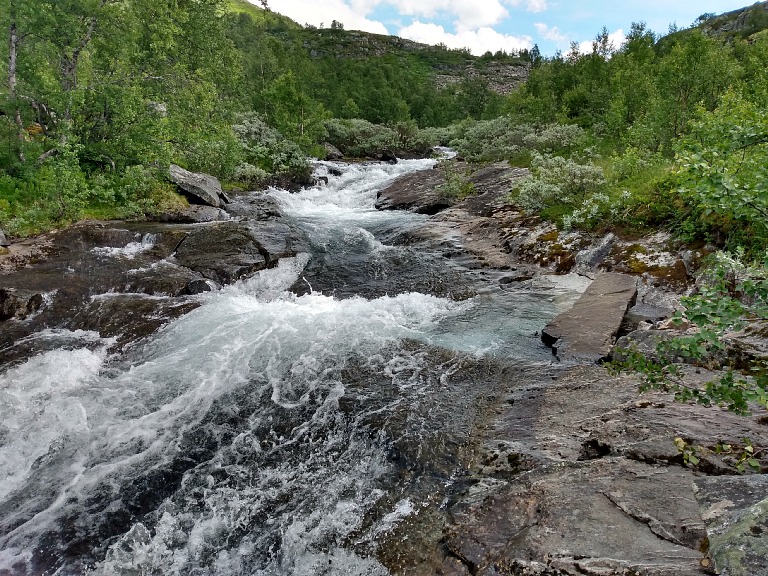
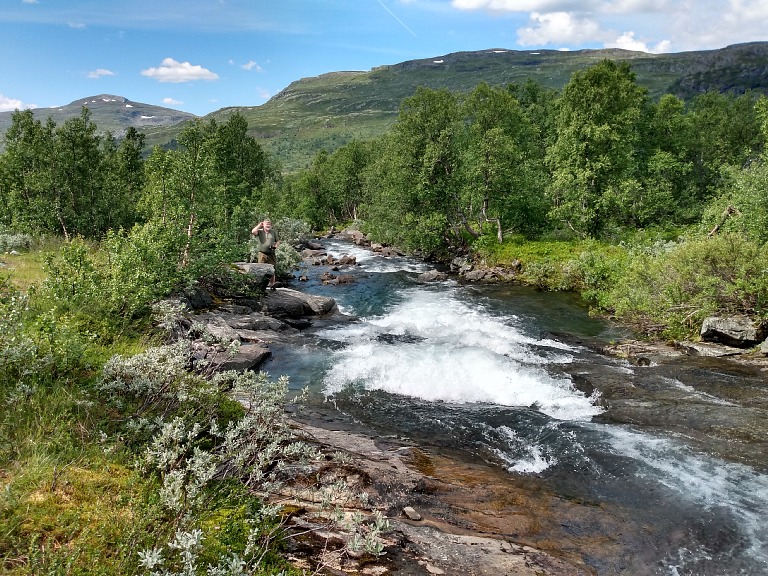
| A magical creek from the glacier, probably named Isdølo, according to maps. |
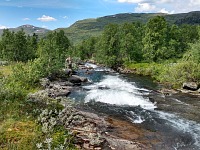 |
| Sid for scale at the creek, (most likely) Isdølo. |
It's easy to understand why Norwegian businesses employ all kinds of temporary
workers during the short summer season (in the Little Palace it was a Slovak,
a Cameroonian, and a Spanish-speaking cook + Norwegian owners; Russian was
commonly heard at many restaurants). It seemed to us that at Fossli, the problem
was rooted in a mono-culture of the staff besides front desk. Their shared
ethnic mentality projected into all aspects of hotel service. We found a crate
with CLEAN glasses, being distributed to hotel rooms on our floor, being left
laying on the dirty corridor carpet; a server could be seen wiping alternatively
the dining hall floor and guest tables, using the same rag; staff vigorously
smoking right under open windows of guest rooms, and so forth. Socialist,
indifferent attitudes and botched jobs gave us real pause — despite a nice
and friendly receptionist at the same Fossli hotel.
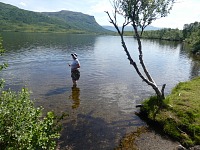 |
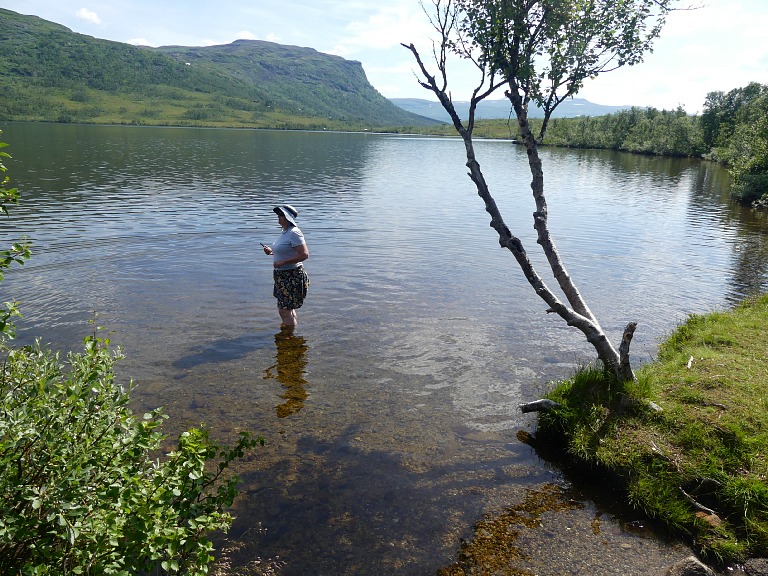
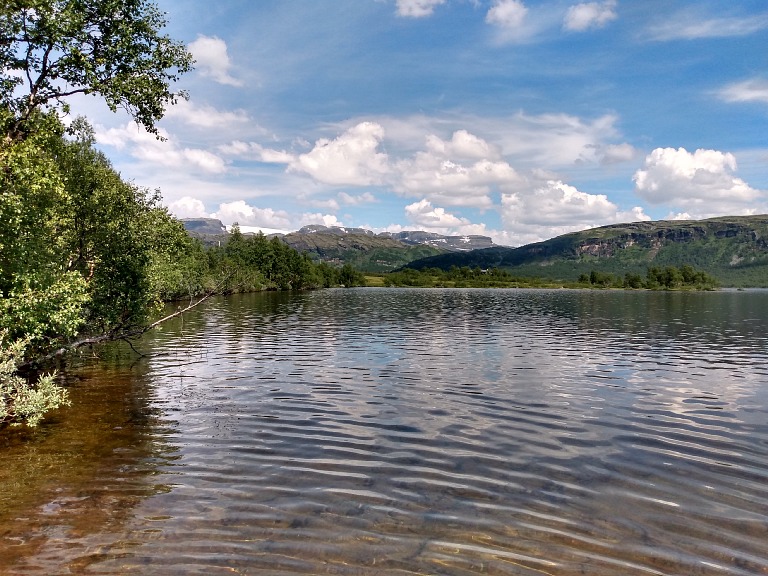
| Isdalsvatnet offers only bathing in the heat, not so much swimming. |
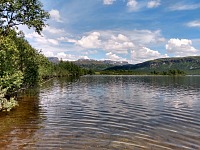 |
| The glacier that feeds the lake's waters, warmed up now, can be seen from it. |
Still, we did not come there for hotel stays, but for the nature — thus we
did not let it spoil our trip, and instead we went to properly exploit
Vøringsfossen from all its sides. I grant that the system of trails and viewing
platforms and bridges is amazing — we spent two hours on them. We took 280
pictures and still not one can capture the entire atmosphere of such a giant
waterfall. Before we returned to the hotel, it became hot again, and so we
packed our swimsuits, jumped in the car, and went to check out Isdalsvatnet.
Finding the lake was easy, only we could not locate any suitable bathing spot
(which would offer access and still not put us in someone's back yard). We drove
upstream above the lake to the end of the road, and continued on foot a bit
along a beautiful mountain stream. Various tourist trails diverged from there
into the mountains, but we did not feel up to it (in the horrible heat). So we
turned back and tried bathing in the lake anyway — bathing is the right
word, as it was only about knee-deep, and proper swimming out of question
— still, now I can claim that in Norway, I'd bathed not only in the North
Sea, but also in a glacier lake!
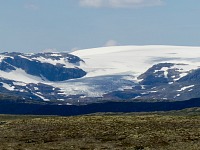 |
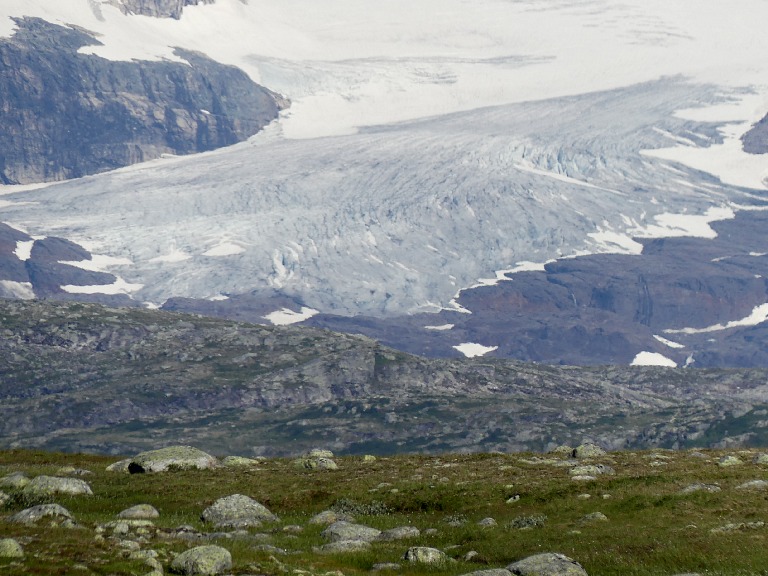
| A glacier is also nicely visible from the plains of Hardangervidda. |
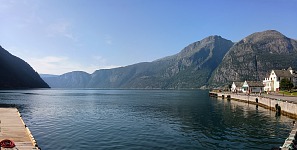 |
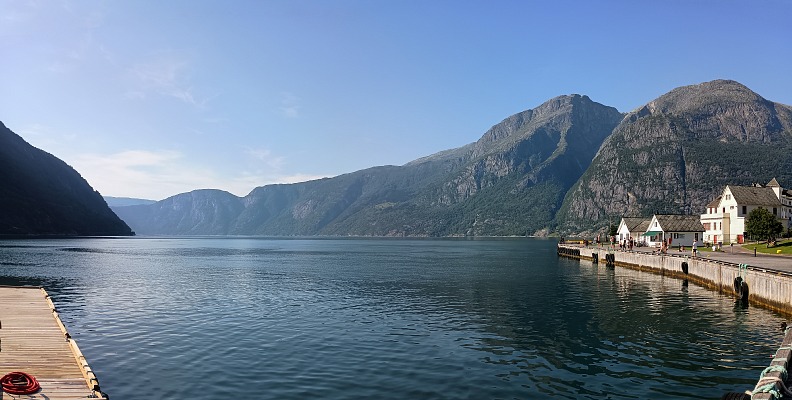
| Down in Eidfjord town we're back at the sea, that is, Hardangerfjorden. |
From the lake we embarked on a mission to find dinner, as we did not feel like
(expensively) eating at Fossli again. Yet we underestimated the general
Wyoming-like nature of Hardengervidda — though according to navigation,
there were supposed to be several restaurants in the vicinity, on closer
inspection we found them generally incredibly crowded mountain lodges (on a
beautiful Saturday in the middle of summer break), offering sandwich-level food
and re-heated pizza, instead of proper meals. Eventually we gave up and drove
down past Fossli to Hardangerfjorden and the town of Eidfjord, with bustling
civilization in the shape of a Thai food street vendor. We did not save much
money (and had to pay even for water — sort-of extreme in Norway), food
was nothing much, but it was different. I noticed a local bath, where swimmers
jumped from relatively high pier right into fjorden — this seemed too
harsh even for the yeti, and I think it was happy to not have brought a swimsuit
along.
 |
| Bjoreio River flows out of Hardangervidda through Vøringsfossen, until it reaches Hardangerfjorden. |
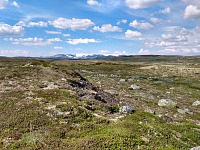 |
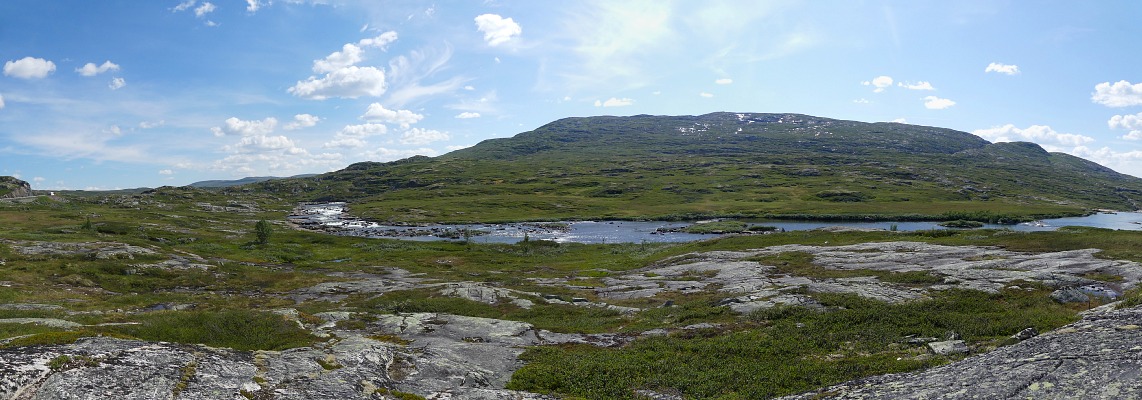
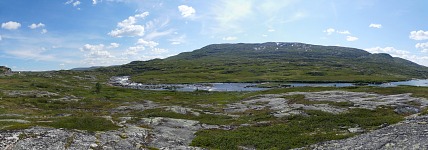
| Hardangervidda landscape is a bit like a very wet Wyoming. |
Sunday, twentieth of July, was our last whole day in Norway, which we planned to
fill with driving through Hardangervidda and reaching Oslo. Vidda was saturated
with tourists; there's really only that one road crossing it, which was
surrounded by caravans and tents and vacationers. Still we found a spot where we
were able to amble to a creek and take pictures of a glacier (for a change).
I think it was that morning when we met the local automated grocery store
— door to the store would only open if you presented your phone with
a payment system app or a radio chip-equipped credit card — then you'd
select your purchases and pay at a self-checkout. I get that it's hard to keep
a store clerk in such a deserted place, but I wonder what we would do if we only
had cash — or what local tourists do if they reach a store with, God
forbid, a dead battery in their phone?
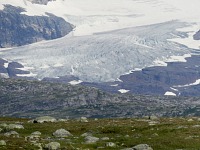 |
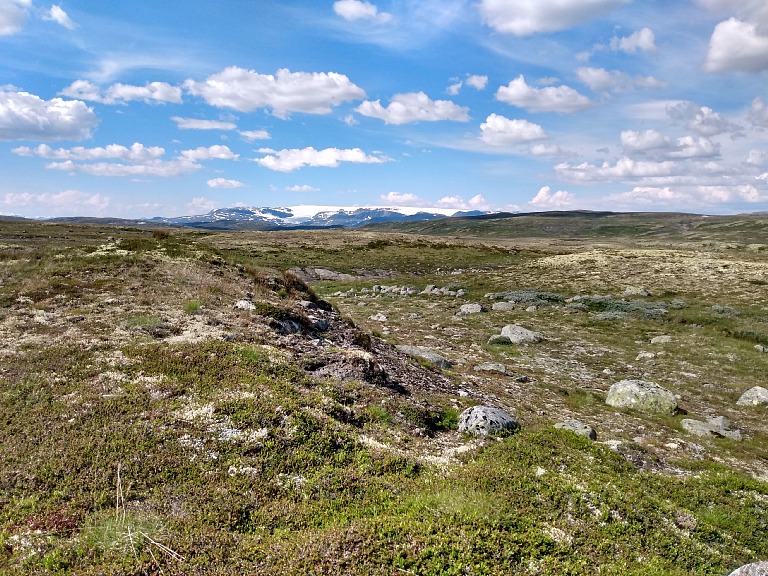
| This glacier is called Hardangerjøkulen. |
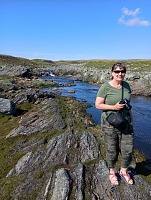 |
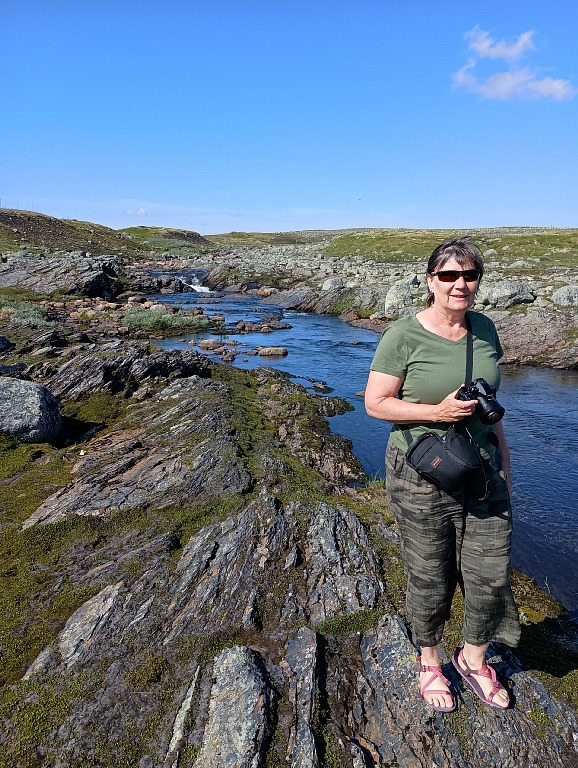
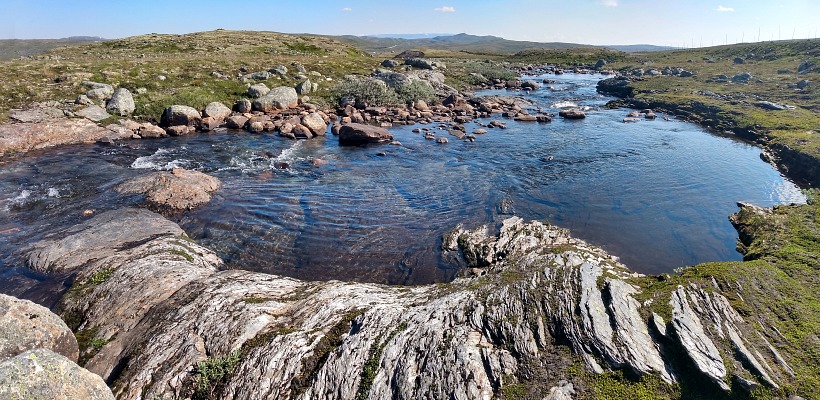
| In Hardangervidda we stepped out into the landscape near Skulevikåna Creek. |
We headed straight for the airport, avoiding Oslo proper. Best to return the car
with a full tank, and a nearby gas station serves that purpose. It also abounds
with several tens of charging posts for EVs — every single one was
occupied and a long line queued to them. We were again glad that our car, though
being a hybrid, did not need charging — it would have extended our
returning it by several hours. The actual return was rather brisk — and
soon we stood on a Flytoget platform, awaiting our train to the hotel — we
decided not to experiment and reserved the same Scandic as we had on our
arrival. Yet there was trouble with trains, as one connection dropped out.
The platform was filling with tired, unnerved people, station announcement
system was muddying the waters and electronic signs kept shifting time of next
train arrival one minute at a time (instead of fessing up to the fact that there
would be no train this time around — this was a terminal, so they had to
know that they had no train to send out).
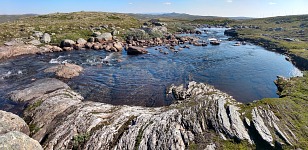 |
| Hardangervidda: downstream Skulevikåna. |
After this delay, we finally reached our hotel midst urban mugginess —
unfortunately our old room (with two beds) was unavailable, but the receptionist
offered us a room for disabled guests. And we all had a laugh when she tried to
carefully break it to us that they had no air conditioning. We assured her that
we would be fine, and she was visibly relieved — she said she was tired of
explaining again and again to tourists that they really DON'T install air
conditioning in Norway, because it's, well, NORWAY.
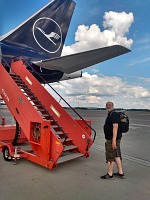 |
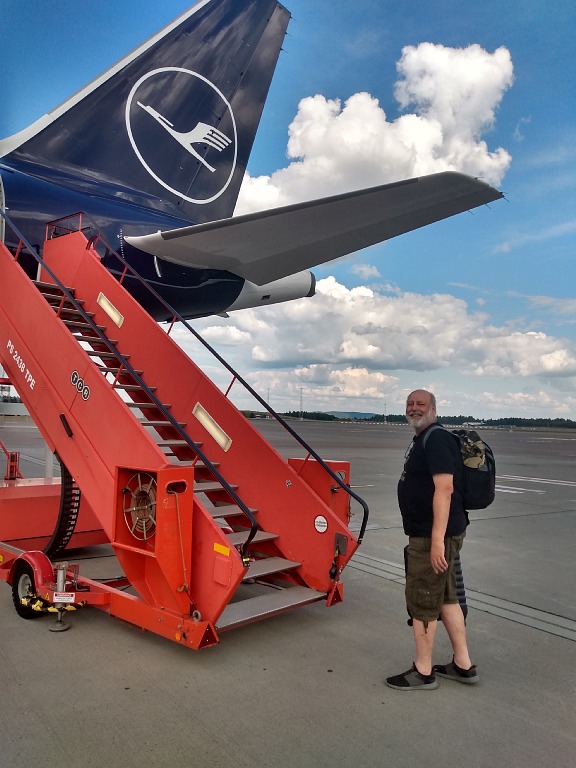
| Leaving Oslo, higher class passengers were offered priority through the jet bridge (trunk). |
Feeling hungry, we headed to the tried and tested sushi place across the street,
where we intended to take advantage of their all-you-can-eat buffet —
well, they sold us their "buffet", but no food would get added to the
already sparse counter. Then we spotted sparrows flying in to pick up bits from
it — that was entirely
disgusting unhygienic.
We hoped they would correct this, but no more food would arrive even after half
an hour, much less chasing off the birds. Thus, at the closing of our trip, we
made a bit of a scene. They gave us a discount, but could not dispel our
disappointment.
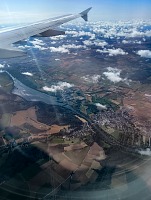 |
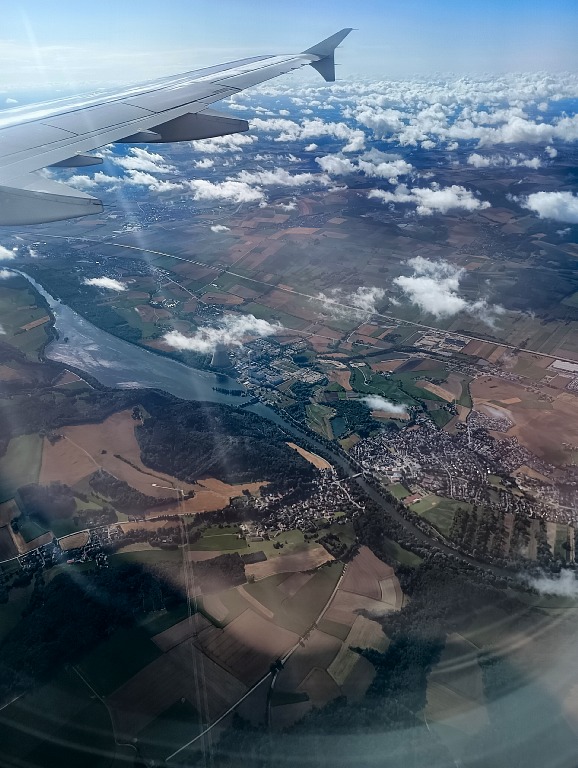
| Niederaichbach on Bavarian River Isar, a stone's throw from Munich. |
It got better in the morning — with an excellent breakfast at the hotel,
and more importantly, professional courtesy of the staff. Two large tourist
groups departed just as we arrived to the breakfast hall. We enjoyed spaces
freed thus, and I jumped at my favorite yogurts. Sid was unhappy on account of
not finding his smoked salmon, which he grew very fond of in Norway. I reckoned
it strange, so in the course of my next sortie for coffee, I intercepted
a server and asked her, why there was no salmon that morning. She gazed at me
uncomprehending, knowing no English. I rummaged in my memory and pronounced
the magic word, "fisk". Person cheered up and said "something
something laks something" (
laks being salmon in Norwegian, I knew
that too) and pointed to the kitchen, running off in there — and in
moment returning with a plate of Hippo's favorite delicacy.
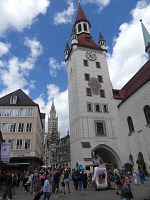 |
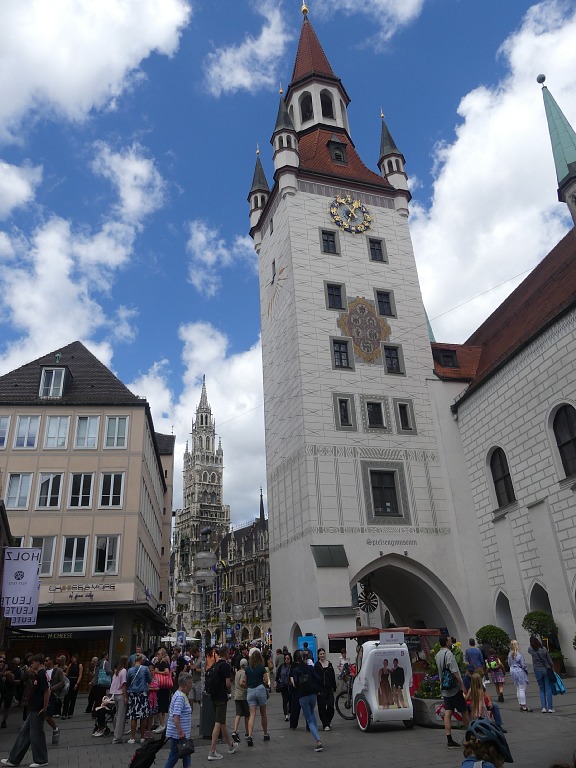
| Old and New Munich Town Halls from historic Farmer's Market. |
All we had left was packing and getting back to the airport. We were a bit
worried whether our big bag would fit the weight limit — we repacked so
that we could each live from our respective carry-on bag, while the big bag
contained mostly dirty laundry and hiking boots that we would not need again.
The complication was again of the digital nature — Oslo airport is fully
automated — you print your own baggage tag, stick it on, scan it and push
the bag into the maw of the machine, which would weigh it and swallow into the
innards of the airport. Who knows what happens if the scanned baggage is found
heavier than limit? Would the machine disgorge it? What then of the scanned
code, now attached to the overweight baggage? Would you have to pay extra for
a new baggage, or what? Fortunately for us, we met the limit, and did not have
to deal with such basic questions, but I'm still frightened by the idea that
one gets stuck in a non-logical loop of an automated system, without an option
to exit the loop or escalate.
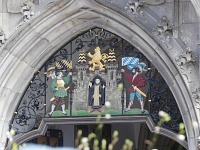 |
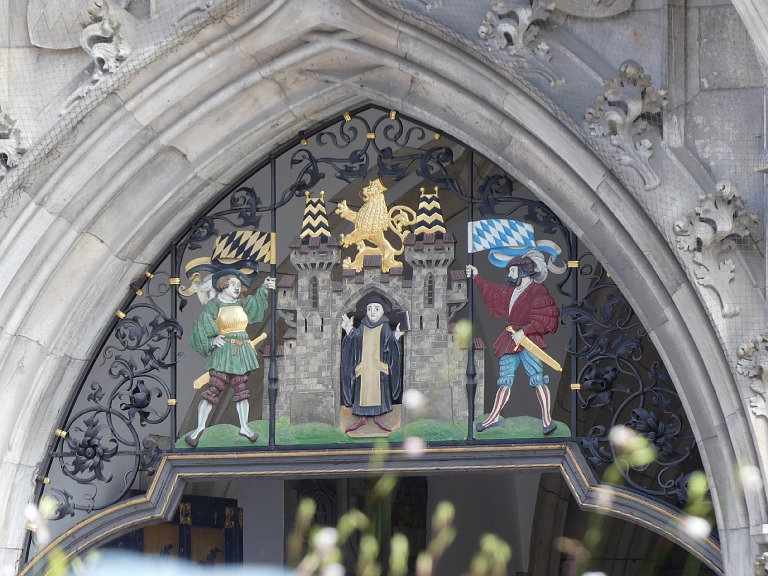
| Munich (monk-like) child symbol over entrance to the New Town Hall. |
Subsequently we flew to Munich without no issues, and since Vicky awaited us at
the airport, we did not even need to fight through the S-Bahn ticket system on
our own. An extra cherry on the cake then was the (excellent) home-made dinner,
especially after two weeks of eating out (with two exceptions, when cooking with
friends).
On the following day we immersed ourselves in the rush of the metropolis.
Although I had been to Munich several times before, I actually had not seen the
very down town — so we visited the Town Hall with its Glockenspiel, which
to my medieval pleasure includes knight jousting with lances. I insisted on
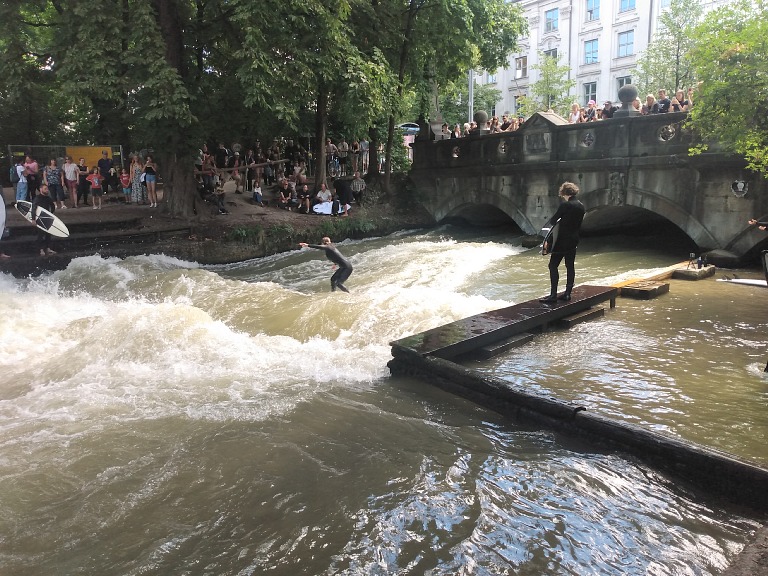
seeing the Wave and urban surfers, which fascinated me by being such an
outdoorsy affair in the middle of a city. Vicky claims that locals float on the
creek in the summer and then take public transport upstream again wearing
swimsuits, but we spotted no such swimmers. Then, fortunately, came time for
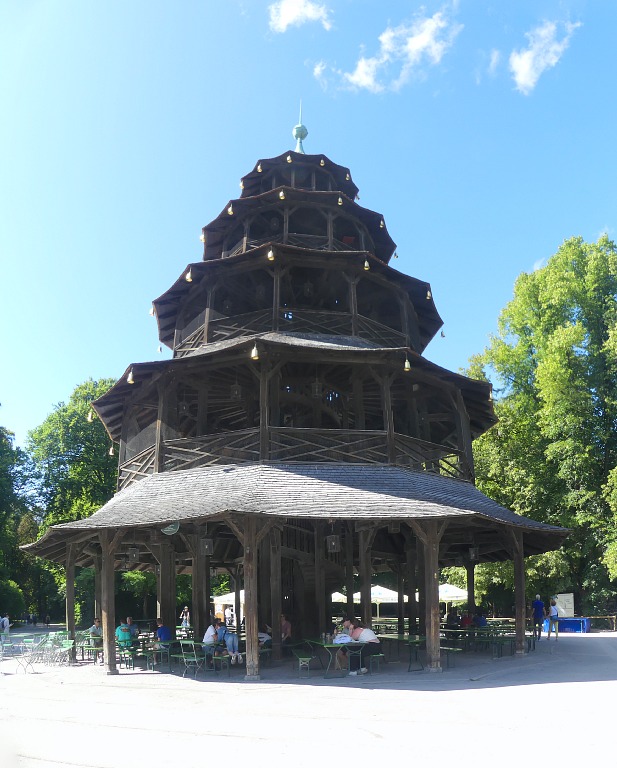
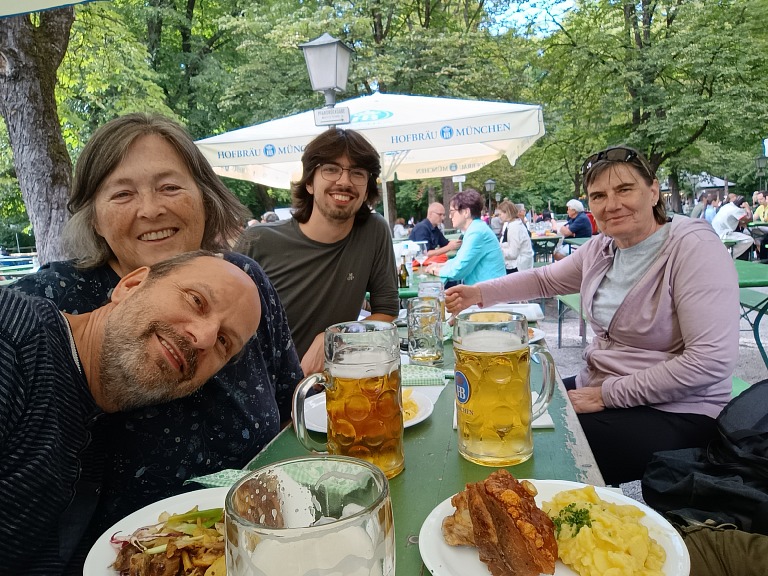
BIERGARTEN; this time we visited the largest and most famous one at the Chinese
Tower, where Holger and Oliver joined us.
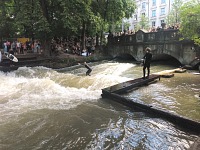 |
| Eisbachwelle: urban surfing is a popular curiosity. |
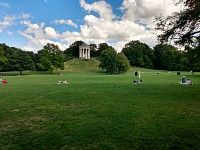 |
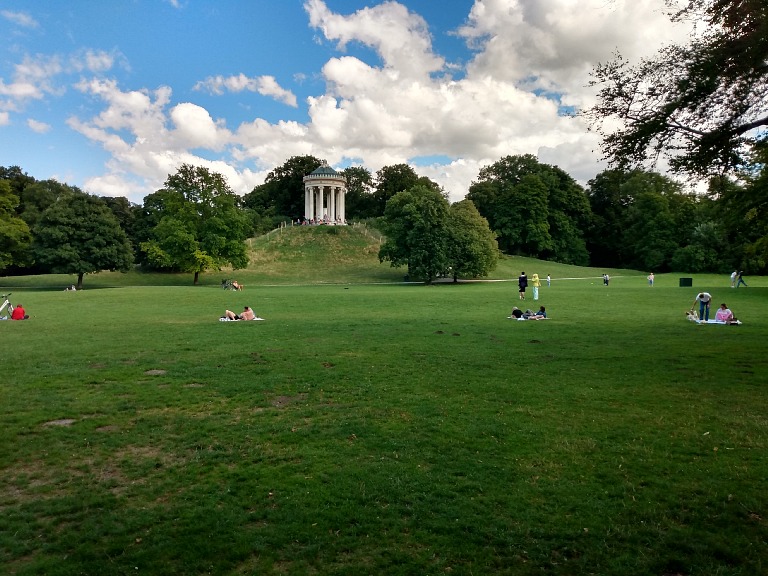
| Monopteros pavilion in English Gardens. |
On Wednesday the twenty third, Sid had his flight home to Wyoming, and I counted
on taking a train to see my family in Prague. Yet, Deutsche Bahn reached
a conclusion this year that they would have nothing to do with me, and to be
sure, removed rails from direct lines to Prague, with all connections canceled
(unless, of course, you would WILLINGLY undergo various bus bridgings, detours
etc., like, going via Austria). I had no other option than to try Flix Bus.
Well, I can cope with the constraints of limited space. I understand chaos at
the station when at time of MY bus's departure, the previous one had just made
an appearance. My fellow passengers were the last drop. By their language
I would venture a guess that most of them were Romanians; and even those not
wearing sweat pants and instead dressed normally, were considerably ... ripe.
Exacerbate the problem with a glass viewing roof of the bus; our first and only
stop at Czech border being devoted to frantic purchase of quantities of beer,
while the rest of the break is dedicated to vigorous smoking, which turned the
un-ventilated space of the bus, liberally heated by sunlight (there was air
conditioning, but never had a chance), creating an environment in which one had
the impression than one breathes raw sewage instead of air.
Eventually I discovered that the lower deck of the bus suffered a smelly
toilet, but in comparison to sun-roasted passengers reaching combustion
temperature, a toilet is actually refreshing. I moved downstairs at the price of
donning a sweatshirt (the air-conditions was effective there) and sitting
against the direction of our journey — and thus I survived.
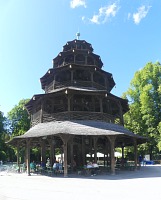 |
| In the middle of English Gardens is found the Chinese Tower, surrounded by a Biergarten. |
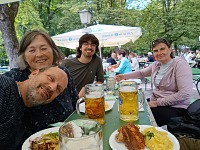 |
| Having food and beer in Biergarten: Vicky + Holger + Oliver + Carol. |
I stopped just for a few days in Prague, to see family and a few friends.
This worked out very well and then I was to fly with Aer Lingus via Dublin. It
was much cheaper than a direct flight from Munich (which I would have hard time
to get to, especially if I did not experience another painful trip with Flix
Bus) — and in the end, it worked out quite well, time-wise. Departure from
Prague around noon meant that I could get comfortably to the airport, which
is a Prague specialty (no train or other reasonable direct connection from the
city exists), without having to get up as some unhealthy hour. Dublin airport
then includes border and customs control into United States (so later in Denver
we just disembarked through the local portion of the airport and collected our
bags, no more lines and hassle). All that went relatively quickly, and I had
the impression that I could manage to eat something before my transatlantic
flight. I was rather distracted by my need to find in the very limited offerings
of restaurants (count them: one, and with a long line) and cafes something that
was not a sandwich (and what I can ingest with my GF diet), that I almost missed
my flight. I was simply so confused by all the changes and languages and time
zones and civilizations that I missed noticing the time; I left the cafe
sweating with fear. I almost got a heart attack when I spotted no travelers at
my gate, only two stewardesses, but they smiled kindly — and so I only
missed waiting in a line for boarding. Still I didn't manage to fill my water
bottle — thus I had to ask them on the plane — they issued me one
liter bottle, which lasted me for the rest of the flight. Not just that —
Aer Lingus gives you so much space between seats that I could store this bulky
bottle in the seat pocket in front of me, and still have room for my knees.
This considerably improved the culture of my travels — finally I stopped
feeling like a beast being led to slaughter, and felt like a normal, ordinary
human being.
I was returning home from our vacation in a state of total satisfaction.
Sometimes, one returns home regretting that it's over; other times one can't
wait to get back to one's own. This year it all worked out wonderfully. There
was no regret, only happiness how it all went well.